Embedded deposits
Fabric · Nucleus BankOS moduleWhite-label accounts, held on the bank’s ledger.
Embedded deposits are bank accounts a non-bank partner offers under its own brand while the sponsor bank holds the funds. On Fabric, each end user’s account and balance sits on the bank’s core, with cards, statements and payments built in.
At a glance
- Account structures
- Accounts per end user, or FBO with sub-accounts
- Balances
- Ledger and available, per end user
- Cards
- Virtual and physical debit, mobile wallets
- Money movement
- ACH, RTP, FedNow and book transfers
- Documents
- Monthly statements and 1099-INT
- Templates
- Five, each fully editable
Specifications
Program templates and account features
| Retail banking | White-label checking and debit for a consumer brand |
|---|---|
| Investment fund | FBO sub-accounts for capital calls and distributions |
| Gig wallet | Instant-issue wallets and virtual cards for same-day earnings |
| Marketplace payments | Per-seller virtual accounts, split payouts, escrow until delivery |
| SMB treasury | Operating, payroll and tax-reserve accounts with a yield sweep |
| Balances | Ledger balance (posted) and available balance (after holds), point-in-time on request |
|---|---|
| Holds | Card authorizations and administrative holds reduce available balance without a posting |
| Transactions | Search by status, date, source or amount; merchant name and category where available |
| Statements and tax forms | Monthly PDF statements; 1099-INT and 1098 when issued |
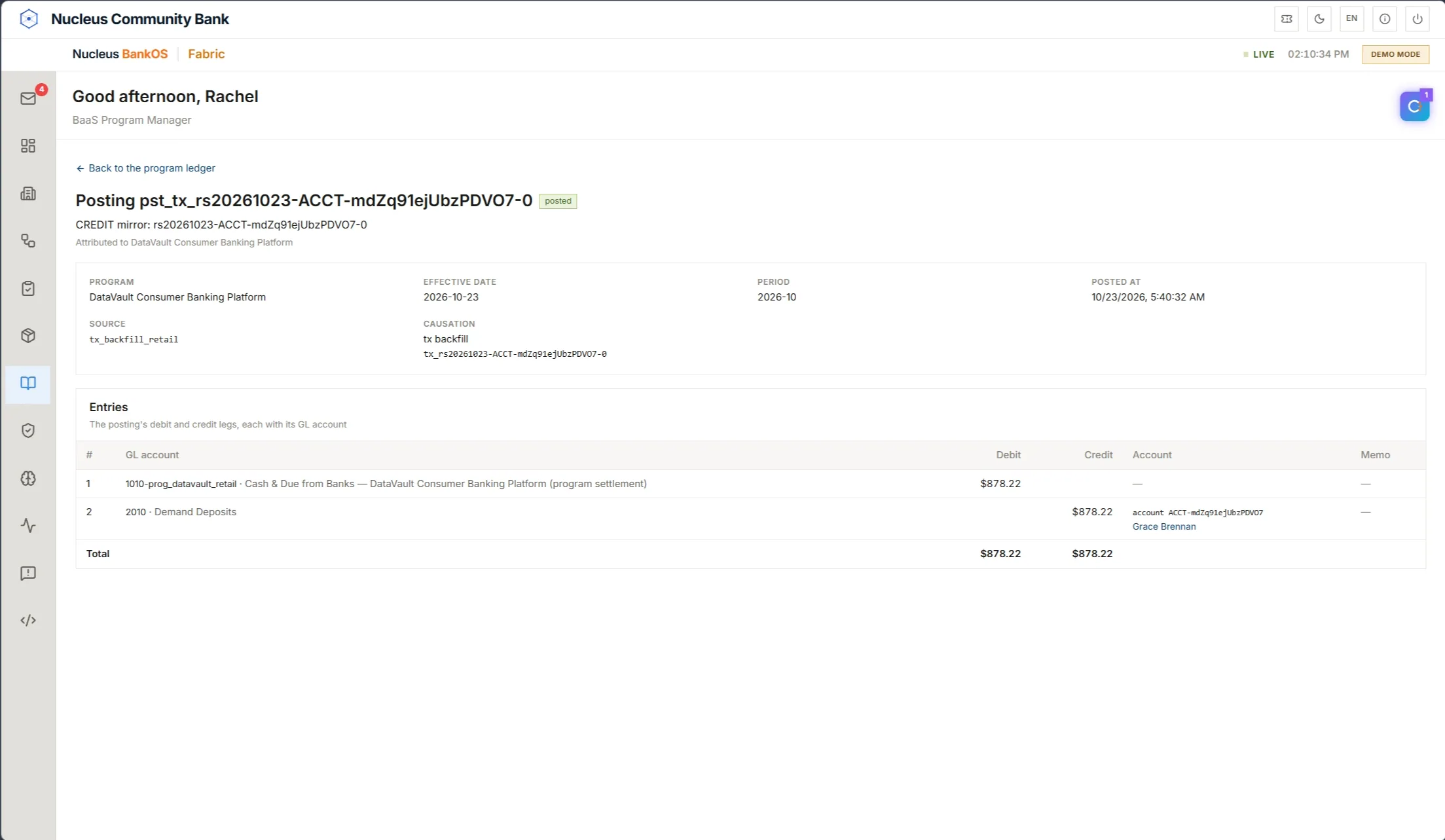
| Reconciliation | Sub-ledger posts double-entry to the general ledger; breaks are raised as findings |
| Events | Signed notifications when a transaction posts or a statement is ready |
Questions
What people ask
What are embedded deposits?
Embedded deposits are checking, savings or wallet accounts offered inside a non-bank company’s product, with a chartered bank holding the money. The partner owns the experience; the bank owns the account and the regulatory obligations.
Should a program use individual accounts or an FBO account?
Both work on Fabric. Individually opened accounts suit consumer and SMB programs; an FBO structure with sub-accounts suits pooled money such as fund capital calls or marketplace escrow. Either way, each end user’s balance is recorded on the bank’s core.
How is each end user’s balance reconciled?
Every movement posts as balanced double-entry legs to the bank’s general ledger, with balances held per end user and per program. Where a sub-ledger is kept outside Nucleus, a daily tie-out compares it with the general ledger and raises any drift as a finding.
Can the partner brand the accounts and cards?
Yes. The partner’s app, onboarding and cards carry its brand, and the onboarding flow is edited per program in Fabric Studio. The bank remains the institution that holds the deposits.
Are embedded deposits FDIC-insured?
That depends on how accounts are titled and whether the records identify each owner and balance, so the bank and its counsel make the determination. Fabric keeps those per-end-user records on the bank’s core and tracks coverage per partner.
Related
Keep reading
Module
Fabric
Banking-as-a-service on Nucleus BankOS.
For sponsor banks
Sponsor-bank controls
Who sets what, how partners are supervised, and the record examiners read.
For developers
Partner APIs
What partners integrate, how they connect, and how calls are governed.
Illustrative case study
White-label investor DDAs
A scenario: per-investor accounts for a private-markets partner.
Bring deposits in through your partners.
A working session on the program you want to launch and the template it starts from.