Fraud · cyber · AML · BSA
Stop fighting financial crime in four silos.
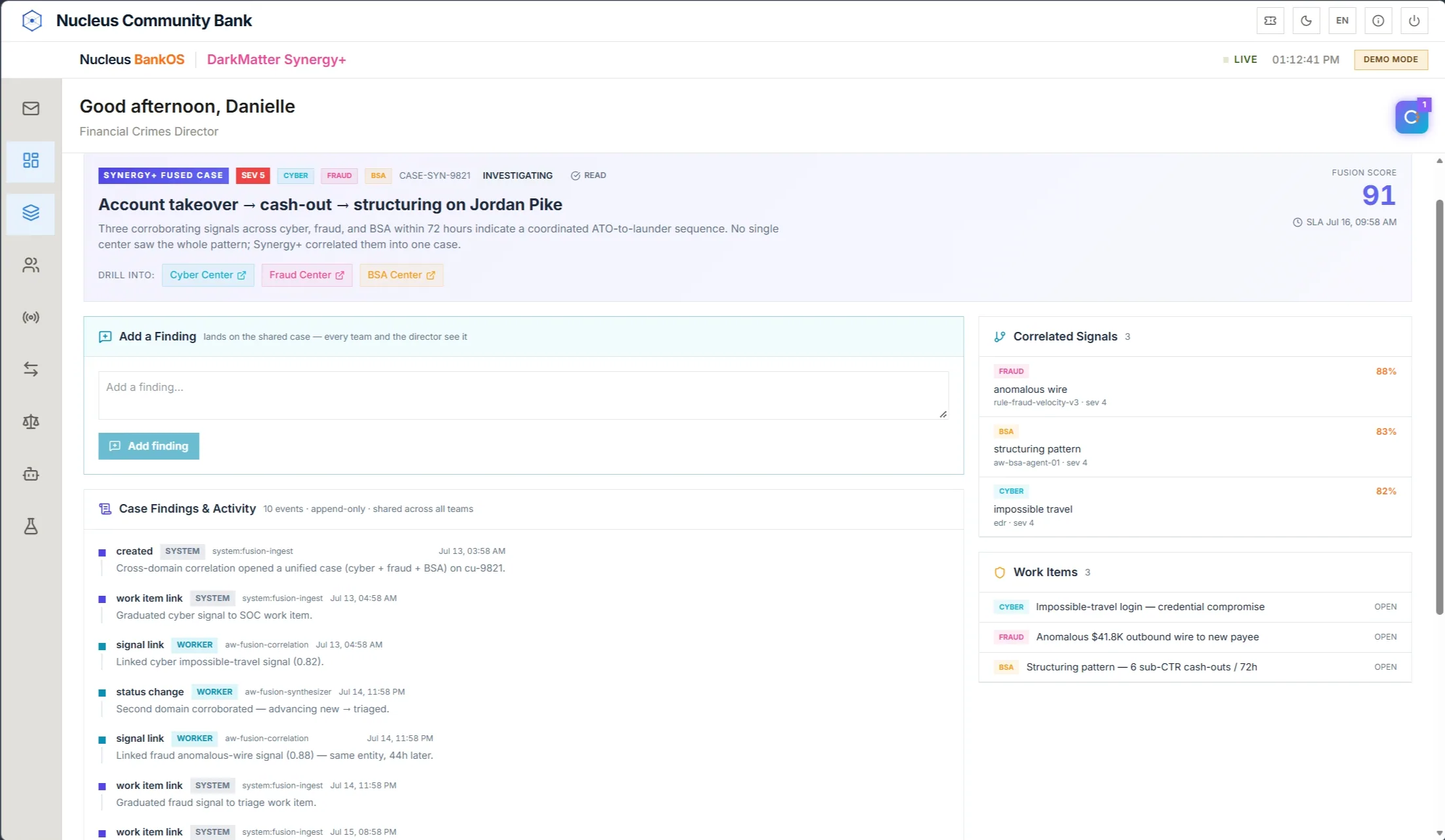
Fraud, cyber, AML and BSA synergy is how community banks run one investigation instead of four: DarkMatter is native to Nucleus BankOS, and the DarkMatter Synergy+ add-on correlates every domain onto one case file.
The problem
Separate systems create the blind spots criminals use.
Four systems that can’t see what the others know.
Batch updates and isolated queues.
Alerts that wait for someone to speak up while losses mount.
The workflow
Four defenses, one case file.
Signals correlated in real time
Cyber, fraud, BSA and compliance signals are normalized and shared across every team as they happen.
One case, one log
A fraud alert and a BSA alert on the same customer become one investigation, with one immutable, replayable record.
SAR drafts for officer review
Timelines and entity data are pre-assembled; the compliance officer reviews, decides and signs.
Bank-controlled rules
The bank sets rules, threat feeds and scoring thresholds, and keeps its SIEM.
Model it, then see it
Test it against your numbers
Build your business case
Model the cost of the fraud, BSA and compliance tools you run in parallel today.
Side-core and full-core results shown separately, as ranges.
- Automated SAR filing for BSA teamsA hypothetical mid-size bank moves from manual review to SAR drafts for officer sign-off.
- Early account takeover preventionBehavioral signals stop takeover attempts before funds move.
Illustrative scenarios: a hypothetical institution with modeled outcomes, not a customer deployment.
Questions
Fraud, Cyber, AML and BSA: what banks ask
Why fuse fraud, cyber, BSA and compliance into one system?
Because financial crime moves across channels and product lines, and four separate systems leave blind spots between them. DarkMatter Synergy+ correlates all four domains in real time on one case file, so related alerts become one investigation instead of two.
What’s the difference between DarkMatter Synergy+ and a SIEM?
A SIEM ingests logs. DarkMatter Synergy+ ingests the bank’s financial-crime signal — customer behavior, transactions, device fingerprints, KYC/KYB state — and correlates it. It integrates with your existing SIEM rather than replacing it.
Does this require ripping out our existing fraud or BSA vendor?
No. DarkMatter Synergy+ can run alongside existing fraud and BSA tools in a side-core deployment and replace them in waves as the bank validates each domain.
Can we control the rules, or is it a black box?
The bank controls the rules, threat feeds and risk-scoring thresholds. The AI normalizes signals and surfaces high-likelihood threats; the bank’s policy decides what action follows.
Is automated SAR drafting accepted by examiners?
SAR drafts are pre-populated for compliance officers to review and sign, so the human remains the decision-maker. What changes is that analysts spend their time on judgment, not on assembling timelines by hand.
Bring the workflow you want to change.
A working session with the founders on your use case, your core and your first step.