Embedded finance
Embedded finance where the credit stays under your charter.
Embedded finance is how community banks run partner-brand programs on their own core: Fabric issues deposits and credit through governed APIs, posts every partner to a subledger of the core GL, and leaves KYC, risk and the ledger of record with the bank.
The problem
Most BaaS is a deposit pipe the bank can’t see into.
A checking account and a debit card, reconciled by middleware.
Credit handed off to someone else’s system.
The bank holds the risk and captures the thinnest slice.
The workflow
Both sides of the balance sheet, for every brand.
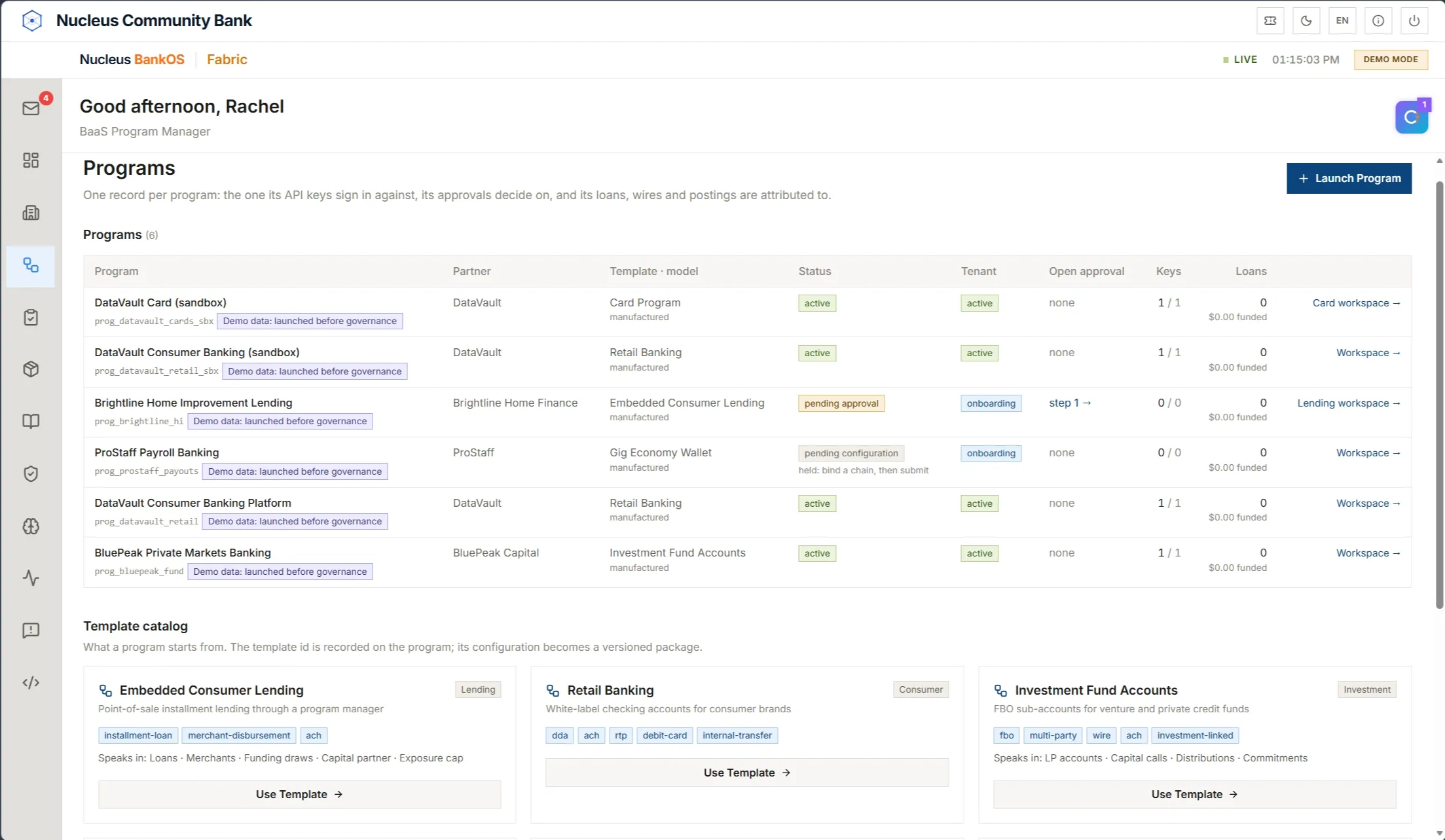
Programs from templates
Deposit and credit programs are configured from existing templates, not engineered from scratch.
Learn morePer-partner subledger
Every partner reconciles to the core GL in real time, with no middleware in between.
The bank keeps control
Partners surface account opening; decisioning, exceptions and due diligence stay with the bank.
Governed APIs and a developer portal
Partners build against documented APIs; the bank sets scopes, limits and consent.
Learn moreFirst-class accounts
Every account opened through Fabric carries the same controls, statements and audit trail as any bank account.
Model it, then see it
Test it against your numbers
Build your business case
Model partner-program deposits, credit and the middleware you would no longer pay for.
Side-core and full-core results shown separately, as ranges.
Illustrative scenarios: a hypothetical institution with modeled outcomes, not a customer deployment.
Questions
Embedded Finance: what banks ask
What’s the difference between BaaS and embedded finance on Fabric?
Traditional BaaS is a deposit pipe reconciled by middleware. Fabric runs deposits and credit on one ledger, with a per-partner subledger and the bank keeping KYC, risk and the ledger of record.
Who holds KYC and BSA responsibility in an embedded program?
The bank. Partners can surface account opening in their own branded experiences, but decisioning, exceptions and ongoing due diligence stay under the bank’s control.
How fast can a new embedded program launch?
Programs configured from Fabric’s existing deposit and credit templates can launch in weeks, instead of the multi-year build a custom embedded program traditionally requires.
Is an embedded account regulated like a normal banking product?
Yes. Every account created through Fabric is a first-class account on Nucleus BankOS, with the same controls, statements, reporting and examiner-visible audit trail as any bank-issued account.
Can a community bank compete with money-center embedded-finance offerings?
Yes. Fabric exposes the bank’s own core as governed APIs, so the bank publishes APIs rather than building payment rails, a ledger or a KYC stack. It offers money-center-style embedded banking without becoming a software company.
Does Fabric require Nucleus BankOS?
Yes. Fabric is a Nucleus BankOS module; embedded credit runs on Foundry, with Foundry Advanced for BNPL.
Bring the workflow you want to change.
A working session with the founders on your use case, your core and your first step.