AI workforce
Add-on to Nucleus BankOSAI workers with limits you set.
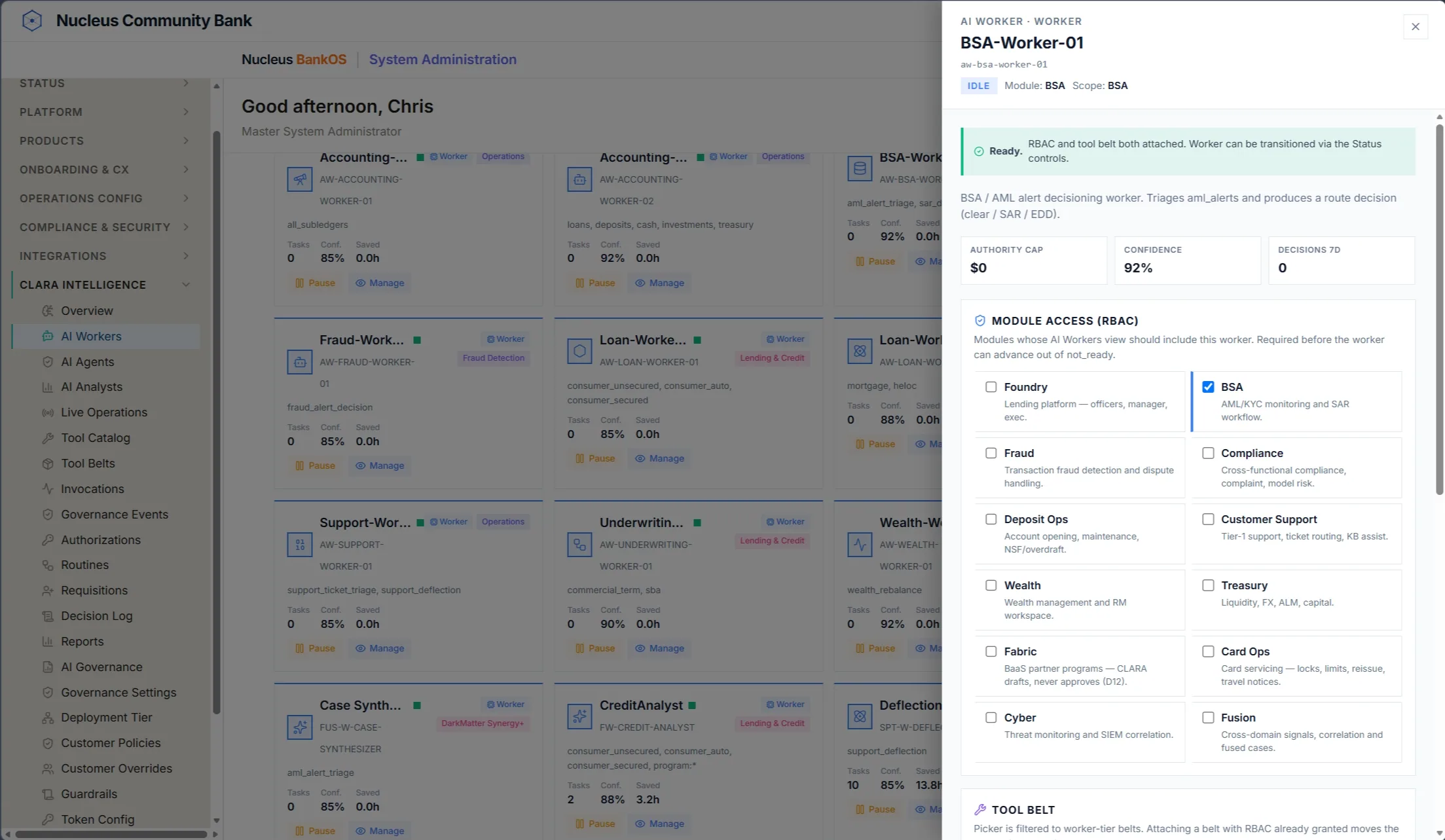
CLARA AI Advanced is an add-on to Nucleus BankOS that extends the CLARA AI built into every deployment with a governed AI workforce for operations and AI features for customers. Every worker acts within limits the bank sets, and every decision can be replayed.
At a glance
- What it is
- Add-on extending the core’s CLARA AI
- Runs on
- Nucleus BankOS, same customer master
- Operations
- Role-based AI workers with authority limits
- Customers
- Money assistant, virtual CFO, service that acts
- Oversight
- Every worker reports to a person
- Models
- Bring your own, or a dedicated adapfin stack
- AI workers
- Authority limits
- Approval chains
- Decision replay
- Virtual CFO
- Virtual teller
- Bring your own model
What it adds
More capacity. The bank keeps the final say.
An AI workforce, deployed by role
Workers for deposit operations, wire review, loan servicing, BSA triage, collections and more, each with an explicit scope. Supervisors tune capacity per department against SLA targets.
Every action clears the bank’s gates
An action is checked against the worker’s scope and authority limit, then routed through the approval chain. Over the limit, the worker escalates instead of acting.
- Scope check on every read and write
- Authority limits per worker
- A person signs off where the bank requires
AI for customers, on their real accounts
A money assistant, budgeting and a virtual CFO for small businesses answer from the customer’s own data. Service chat and a video virtual teller can act, not just deflect, within the scope the bank grants.
Your models or ours
Run the models the bank has already approved, or adapfin’s stack dedicated to the bank alone. Either way the same controls, logging and replay apply.
Specifications
Capabilities
| Capability tokens | Signed, time-limited tokens scope what each worker can read or write |
|---|---|
| Permissions | The same RBAC and row-level security as human staff |
| Customer privacy | Customers are tokenized; the model works the token, not the identity |
| Tool access | Bank-managed MCP assigns each worker an approved set of tools and data |
| Audit | Inputs, confidence and human overrides logged and replayable step by step |
| Roles | Deposit operations, wire review, loan servicing, BSA triage, fraud review, collections, service, reconciliation |
|---|---|
| Authority | Per-worker limits; over-limit actions escalate to a person |
| Supervision | AI Supervisor role scopes, reviews and corrects workers |
| Capacity | Allocation per department with SLA impact previewed |
| Money assistant | Plain-language questions and actions on the customer’s own accounts |
|---|---|
| Budgeting | Categorization, goals and alerts before an overdraft |
| Virtual CFO | Cash-flow forecasting and shortfall alerts for small businesses |
| Virtual teller | Identity-verified video service that escalates to a person |
Questions
CLARA AI Advanced: what banks ask
What is CLARA AI Advanced?
CLARA AI Advanced is an add-on to Nucleus BankOS that extends the CLARA AI built into every deployment. It adds role-based AI workers for operations and AI features for customers, all under the same governance.
How is it different from the CLARA in the core?
Every Nucleus BankOS deployment includes CLARA, the context-aware AI layer. CLARA AI Advanced puts it to work as a staffed workforce and customer-facing features, on the same controls.
Can AI workers make decisions on their own?
Only within the scope and authority limits the bank sets for each worker. Anything over a limit escalates to a person, and approval chains require human sign-off wherever the bank chooses.
How are AI decisions audited?
Every recommendation, action and human override is written to an immutable log with its inputs and confidence. Any decision can be replayed step by step for an examiner.
Does the AI see customer identities?
No. Customers are tokenized and CLARA works the token, not the identity, while answers stay grounded in the bank’s customer master.
Can we use our own AI models?
Yes. Bring the models the bank has already approved, or use adapfin’s model stack dedicated to the bank with no shared inference. The same controls apply either way.
Bring the workflow you want to change.
A working session with the founders on your use case, your core and your first step.