Lending
Nucleus BankOS moduleOrigination to servicing, on one ledger.
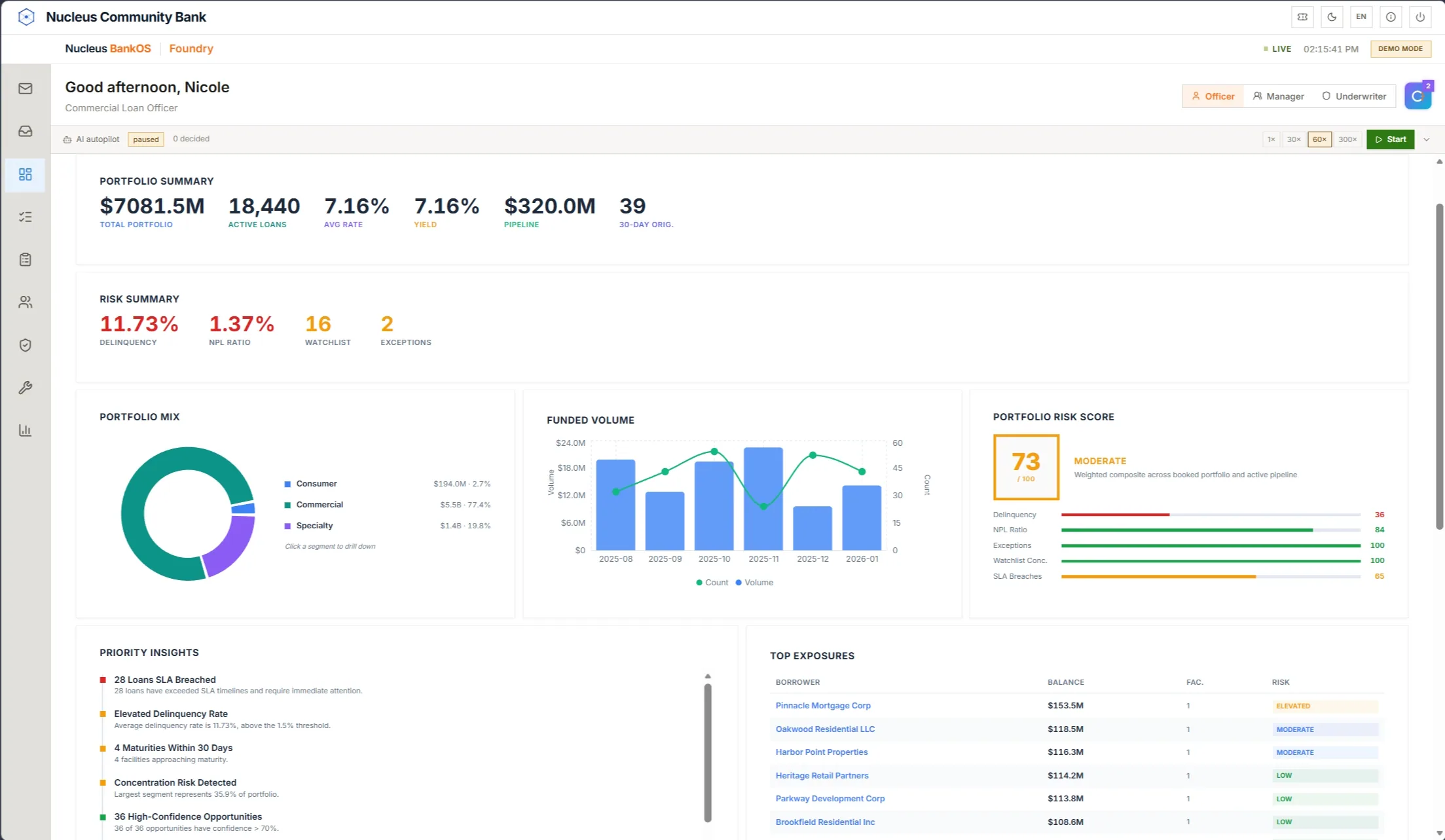
Foundry is the Nucleus BankOS lending module for consumer, small-business, commercial and specialty loans, from application through servicing. Every loan posts to the general ledger as it funds, and AI workers decide only within limits the bank sets.
At a glance
- What it is
- Loan origination and loan servicing in one module
- Loan types
- Consumer, residential, small business, commercial, specialty
- Decisioning
- Bank-written rules; AI workers inside bank-set limits
- Human authority
- Escalations go to a named role; a person’s decision is final
- Ledger
- Balanced GL posting at funding and on every payment
- Deployment
- Full core, or alongside your existing loan core
- Auto
- Personal
- CD-secured
- Boat & RV
- Mortgage
- HELOC
- Small business
- SBA 7(a) & 504
- Equipment
- C&I term
- Lines of credit
- Commercial real estate
- Construction
- Asset-based
- Bridge & mezzanine
- Syndication
What it does
One pipeline from application to payoff.
Credit intelligence and portfolio monitoring
Covenants, borrowing bases and risk grades are tracked on the live loan. Early-warning signals reach the right team while there is still time to act.
- Covenant violation alerts
- Risk-grade migration and watchlists
- Workout and recovery in the same workflow
Origination and decisioning
Officer-entered and partner applications enter one pipeline, from document requests to booking. Credit policy is explicit rules, so every decision carries its reasons.
- Straight-through where policy allows
- Partner intake API with webhooks
AI workers with delegated authority
Each AI worker has a job description the bank writes: products, a dollar cap, ratio tolerances and a confidence threshold. Outside any limit it stops and routes the file to a person.
- Escalates with the limit it hit
- A person’s decision is final
Loan servicing
Payments are applied by the servicing waterfall and post as one balanced entry. Escrow, delinquency, modifications, statements and 1098s run on the same record.
- Payoff quotes with per-diem
- 30/60/90 delinquency buckets
Specifications
What Foundry covers, line by line.
| Consumer | Auto (new and used), personal and debt consolidation, CD-secured, boat and RV |
|---|---|
| Residential | Mortgage and home equity lines of credit, with escrow servicing |
| Small business | Term loans, working capital, equipment, SBA 7(a) and 504 |
| Commercial | C&I term loans, revolving lines, owner-occupied and investor CRE, construction |
| Specialty and structured | Asset-based lines, bridge, warehouse, mezzanine, participations and syndication |
| Embedded | Partner and point-of-sale lending through Fabric, on the same engine |
| Channels | Officer-entered applications; partner loan files (brokers, point-of-sale, fintech) through the intake API |
|---|---|
| File lifecycle | Received → documents required → in underwriting → decisioned → funded or declined |
| Documents | Outstanding items requested and tracked per file; AI extracts data from uploads |
| Straight-through processing | Files the engine can decide skip the human queue; the rest go to review |
| Booking | Loan record and double-entry GL postings written at funding, with no overnight batch |
| Partner visibility | Status and decision by signed webhook; partners never see internal queues |
| Credit policy | Explicit rules per product category, configured by the bank |
|---|---|
| Measures | Credit score, debt-to-income, loan-to-value, debt-service coverage, loan-to-income, revenue |
| Screening | OFAC screening and synthetic-identity risk checks as part of the decision |
| Decision bands | Separate thresholds for straight-through decisions and for referral to an underwriter |
| AI worker limits | Product scope, dollar cap, DTI / LTV / DSCR / score tolerances and a confidence threshold, all bank-set |
| Escalation triggers | Over authority, out of tolerance, low confidence, missing documents, fraud signal, OFAC review, product out of scope |
| Routing | Underwriter, manager, compliance officer, fraud analyst or assigned officer |
| AI-assisted analysis | Financial spreading, document extraction, covenant extraction and credit-memo drafts for officer review |
| Payment allocation | Waterfall (fees, interest, principal, escrow), posted as one balanced GL entry |
|---|---|
| Partial and overpayments | Curtailment or hold, per program policy |
| Payoff | Quote with per-diem interest and a good-through date |
| Escrow | Taxes and insurance collected with the payment and disbursed when due |
| Delinquency | Days past due in 30/60/90 buckets, driving collections and credit reporting |
| Modifications | Rate, term or payment deferral; schedule re-cut, loan history kept |
| Statements | Periodic statements and year-end Form 1098 |
| Covenants | Tracking dashboard with violation alerts and a remediation workflow |
|---|---|
| Borrowing bases | Asset-based lines monitored against periodic borrowing-base updates |
| Risk grades | Grade migration and watchlists driven by early-warning signals |
| Workout | Restructure, forbear or escalate in the same governed workflow, through cure or charge-off |
| Portfolio view | Every loan in customer 360 and portfolio views, including loans held on a legacy core |
| Adverse action (ECOA / Reg B) | Notice generated at decline with the decision’s reasons; sent when the assigned officer closes the file |
|---|---|
| AI declines | Routed to the assigned officer before any notice goes out |
| Consistency | Automated and human decisions run the same rules and are logged the same way |
| Audit trail | Every decision recorded with actor, inputs, policy applied and result |
| Model governance | AI outputs tagged with model, version and provenance; model changes versioned |
| Full core | Foundry originates and services on Nucleus BankOS; Nucleus is the loan system of record |
|---|---|
| Side-core | Loans stay on your existing core; Nucleus projects them read-only and ties the GL out nightly |
| Per data class | Loans can stay on your core while deposits run on Nucleus, or the reverse |
| Partner API | Loan intake and servicing endpoints: scoped keys, idempotent writes, signed webhooks |
Try it — real decision code, simulated applicants
Limits the bank writes. A person with the final say.
Start from
Sarah Parker
Consumer auto · 2025 SUV, new · $38,000 over 60 months
Debt-to-income
35.9%
Loan-to-value
90.5%
Est. payment
$769
Risk score
4 / 100
Underwriting findings
No policy exceptions raised. Credit score 742, income $96,000.
Credit policy 2026-04-25.v1 · evaluated by the same engine the officer’s underwriting tab uses
Runs the same underwriting and authority logic as Nucleus BankOS Foundry. Applicants are simulated and the limits shown are example settings each bank configures. AI decisions stay within the limits your credit policy sets; anything else goes to a person.
Related
Works with
Foundry
Consumer lending
Auto, personal, secured, mortgage and HELOC.
Foundry
Commercial lending
C&I, CRE, SBA, asset-based and structured credit.
Foundry
Loan servicing
Payments, escrow, delinquency, modifications, 1098s.
Core
Nucleus BankOS
The core Foundry runs on: one ledger, one customer record.
Add-on
CLARA AI Advanced
Extends CLARA’s governed AI workers across the bank.
Module
Fabric
Embedded and partner lending on Foundry’s engine.
Questions
Foundry: what banks ask
What is Foundry?
Foundry is the lending module of Nucleus BankOS. It runs consumer, small-business, commercial and specialty loans from application through servicing, and posts every loan to the bank’s general ledger as it funds.
What is the difference between a loan origination system and a loan servicing system?
A loan origination system (LOS) takes a loan from application to funding: intake, documents, underwriting, decision and closing. A loan servicing system manages it after booking: payments, escrow, delinquency, modifications, payoff and statements. Foundry does both on one record, so nothing is re-keyed between them.
What loan types does Foundry support?
Consumer (auto, personal, secured), mortgage and HELOC, small business including SBA 7(a) and 504, commercial term loans, lines of credit and commercial real estate, and specialty structures such as asset-based, bridge, mezzanine and syndicated credit. Each product has its own policy rules, set by the bank.
Can AI make credit decisions at a community bank?
Only within limits the bank sets. In Foundry an AI worker decides a file only when the product, amount, ratios and its own confidence are all inside the authority the bank wrote for it; anything else goes to a person. A person’s decision is final and every step is logged with its reasons.
What happens when the AI worker reaches its limit?
It stops, records exactly which limit it hit, and routes the file to the role the bank assigned: an underwriter, manager, compliance officer or fraud analyst. Its analysis travels with the file.
How does Foundry handle adverse action notices?
Every decline carries the specific reasons it was reached. Foundry generates the ECOA adverse-action notice at decline and routes the file to the assigned officer, and the notice is sent when the officer closes it.
Can examiners see how a loan decision was made?
Yes. Each decision, automated or human, is logged with the inputs, the policy applied, who or what decided, and the result. AI outputs also carry their model version and provenance.
Can Foundry run alongside our existing core?
Yes. The bank sets the system of record per data class, so loans can stay on the existing core while Nucleus projects them read-only and posts balanced entries to one general ledger, tied out nightly. Foundry can also be the full loan system of record.
How does Foundry handle loan servicing?
It runs the amortization schedule, applies each payment through the servicing waterfall, manages escrow, tracks delinquency in 30/60/90 buckets and processes modifications. Statements and year-end 1098s come from the same record.
How do loan payments reach the general ledger?
Each payment is split across fees, interest, principal and escrow and posted as a single balanced double-entry. The allocation is returned with the payment, so subledger and GL agree to the cent.
Does Foundry monitor commercial covenants?
Yes. Covenants are tracked on the live loan with violation alerts and a remediation workflow, alongside borrowing bases for asset-based lines and risk-grade watchlists.
Can partners and brokers submit loans into Foundry?
Yes. The loan-intake API accepts a standard loan file from a broker, point-of-sale lender or fintech partner, and it enters the bank’s own pipeline. Partners follow status and decisions by signed webhook but never see the bank’s internal queues.
Who controls the credit policy?
The bank. Product rules, decision thresholds and every AI worker’s authority are configured by the bank, and the software is yours to run under your own credit policy.
Bring a loan file you want decided faster.
A working session on your products, your credit policy and where Foundry fits next to your core.